


CLUB HISTORY
THE EARLY YEARS
UCC’s story began alongside the University itself.
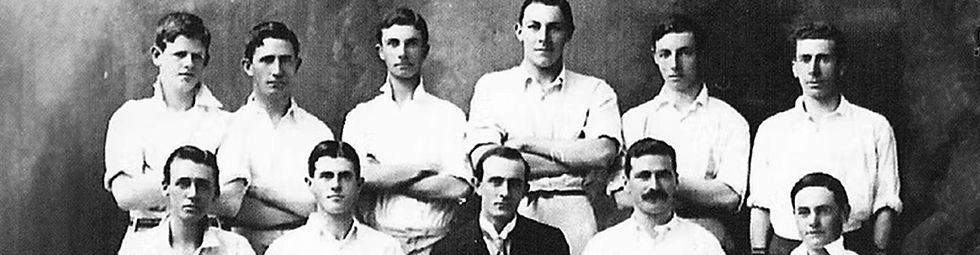
The University of Western Australia commenced teaching in 1913, and University Cricket Club was established that same year, entering the WACA competition for the 1913–14 season.
With UWA then based in Irwin Street, Perth, the Club had no home ground of its own and shared the WACA Ground with East Perth and West Perth.
UCC’s first captain was Philip Le Couteur, UWA’s inaugural Lecturer in Philosophy, a Victorian Rhodes Scholar and Oxford Blue. An exceptional all-rounder, Le Couteur took 83 wickets in the Club’s first season, a record that still stands, along with his remarkable 14 wickets in a single match.
WAR INTERRUPTS PLAY
UCC competed in First Grade in 1913–14, 1914–15 and 1916–17, but the First World War had a major impact on the young Club. As students left to serve, fielding a full team became increasingly difficult and UCC eventually withdrew from the WACA competition.
During the years that followed, the Club continued to play matches against schools and the Teachers Training College.
A NEW HOME AT CRAWLEY
UWA’s move to its Crawley campus in 1930 marked a new chapter for UCC. For the first time, the Club had a home ground of its own, originally known as Crawley or University Oval and later renamed James Oval.
After fielding a Second Grade team in 1929–30, UCC returned to First Grade in 1930–31.
Another milestone followed in 1932, when UCC played its first intervarsity match in Adelaide.

THE GOLDEN YEARS
After a difficult 1936–37 season, UCC spent another decade outside First Grade and virtually ceased operating for three seasons during the Second World War.
The Club re-formed in 1945–46, returned to First Grade the following season and has fielded four Grade teams every season since 1947–48.
The 1950s and 1960s became one of the most successful periods in UCC history. Three First Grade premierships were won in just four seasons: 1951–52, 1953–54 and 1954–55.
Captained by Robin Gray, these teams featured some of the Club’s great names, including John Rutherford, Laurie Sawle, John Forsaith, Eric Strauss, Ray Strauss and Geoff Fernie.
Ray Strauss went on to take an extraordinary 697 First Grade wickets for UCC, while John Rutherford became the first Western Australian cricketer to represent Australia in a Test match.
AN ERA OF SUCCESS
The success continued with First Grade premierships in 1960–61, 1963–64, 1965–66, 1967–68 and 1974–75, alongside numerous premierships in the lower grades.
In 1960–61, Keith Punch took 9/22, setting a UCC bowling record. That same season he also took a hat-trick for Australian Universities against the touring West Indies.
John Inverarity featured in four of UCC’s First Grade premiership teams, captaining the final three. Along with Jock Irvine, Tony Mann and Rod Marsh, he was among a remarkable group of UCC players who also represented Western Australia.
CHANGING TIMES
Following the 1974–75 premiership, changes to WACA eligibility rules made it increasingly difficult for UCC to attract and retain players.
The Club faced an even greater challenge in the early 1980s, when attempts were made to remove UCC from the competition and later amalgamate it with Nedlands. UCC successfully fought to retain its place and independence.
Despite fewer premierships during the decades that followed, the Club continued to develop players capable of representing Western Australia and competing at the highest levels of the game.
UCC ON THE BIG STAGE
Nine Australian Test cricketers have represented UCC during their careers:
John Rutherford · Laurie Mayne · John Inverarity · Tony Mann · Rod Marsh · Wally Edwards · Graeme Wood · Chris Rogers · Ashton Agar
Ken MacLeay also represented Australia in One Day International cricket, while Jock Irvine was selected for an Australian touring team to South Africa.
UCC has also attracted outstanding international players. English Test cricketer Chris Tavare became the Club’s first English professional in 1977–78, followed over the years by players including Mark Ramprakash, Mark Ealham, Ed Smith, Owais Shah, Ian Bell and Nick Compton.

To coincide with the launch of the UCC Foundation in 2001, the Club selected its Team of the 20th Century:
John Rutherford
Rick Charlesworth
John Inverarity (Captain)
Graeme Wood
Jock Irvine
Rod Marsh
Ken MacLeay
Tony Mann
Keith Punch
Ray Strauss
Geoff Forsaith
12th Man: Laurie Sawle
Coach: Robin Gray

John Inverarity
Captain of UCC's Team of the 20th Century and Club legend.
WOMEN AT UCC
UCC entered a women’s team in the WACA B Grade competition in 2013–14 and enjoyed immediate success, winning both the T20 and 40-over competitions in its first season.
Further success followed and led to the formation of an A Grade team. UCC’s women’s program ended ahead of the 2019–20 season following changes to the structure and number of teams in the WACA competition.
A NEW CHAPTER
A change in eligibility rules allowing players without a university connection to represent UCC helped usher in a new era for the Club.
In 2017–18, First Grade reached its first Grand Final in 43 years, finishing runner-up to Claremont-Nedlands. The team returned to the finals in the unfinished 2019–20 season and was also runner-up in the T20 competition.
Players including Ashton Agar, Will Bosisto and David Moody continued UCC’s long tradition of progressing to first-class cricket.
MORE THAN CRICKET
UCC’s influence extends well beyond the boundary.
Former players have gone on to make significant contributions to business, sport, public life and their professions. Among them is former Australian Prime Minister Bob Hawke.
The Club’s player-led culture has always been an important part of its identity. With members taking responsibility for much of the Club’s operation, generations of young players have gained leadership, organisational and management experience alongside their cricket.
In UCC’s centenary year of 2013, former players held some of Australian sport’s most senior positions, including Wally Edwards as Chairman of Cricket Australia and Mike Fitzpatrick as Chairman of the AFL Commission, while John Inverarity and Rod Marsh served on Cricket Australia’s national selection panel.
That tradition of leadership continues today.